If you’ve seen STG pop up in a text message, comment, or DM and paused to wonder what it means, you’re not alone.
Short forms like STG are everywhere in modern digital conversations, and they often change meaning depending on context. People search for “STG meaning in text” because the abbreviation can feel confusing at first — especially if you’re not deeply immersed in internet slang.
In most cases, STG is used to express honesty, frustration, or strong emotion in casual chats. It’s quick, expressive, and fits perfectly into fast-paced messaging on platforms like WhatsApp, Instagram, and TikTok.
This article breaks down exactly what STG means, where it came from, how people use it today, and how you should respond when someone sends it to you. Let’s decode it in plain English.
What Does STG Mean in Text & Chat?
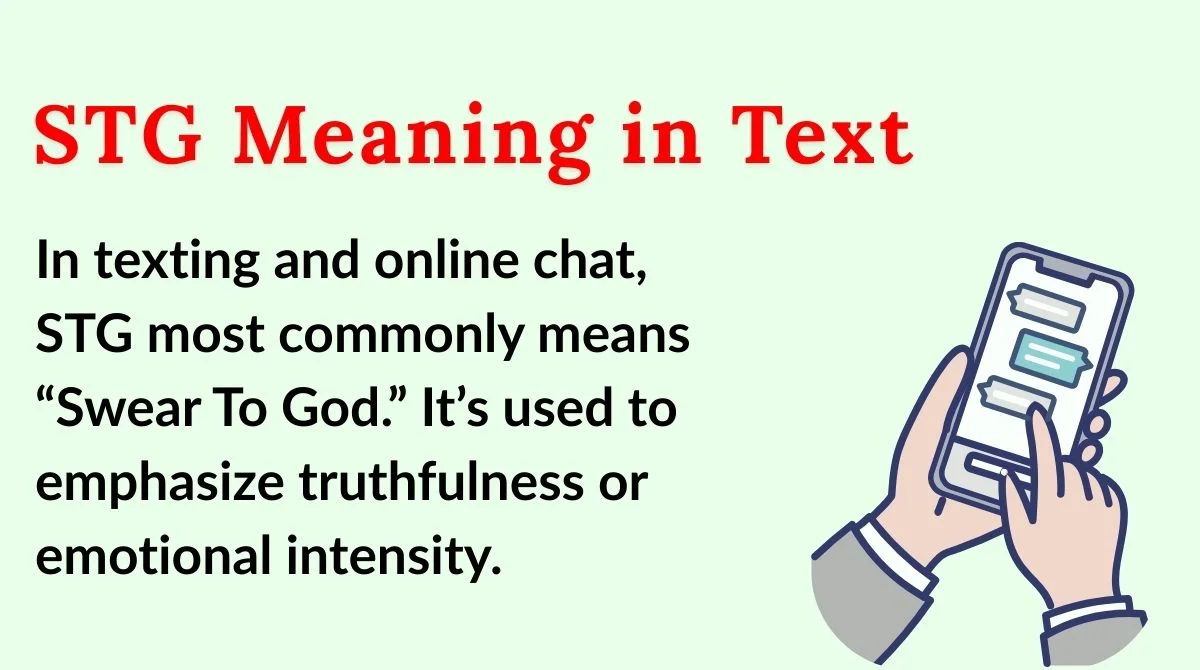
In texting and online chat, STG most commonly means “Swear To God.” It’s used to emphasize truthfulness or emotional intensity. When someone says STG, they’re usually stressing that they’re being serious, honest, or completely done with a situation.
STG often appears when emotions are high — excitement, annoyance, disbelief, or frustration. It works like verbal emphasis in spoken language, similar to saying “I promise” or “I’m dead serious.”
People use STG to:
- Show they’re not joking
- Add emotional weight to a statement
- Express annoyance or disbelief
- Reinforce honesty
Quick examples:
- “STG I didn’t touch your phone.”
- “STG this traffic gets worse every day.”
- “If he’s late again, STG I’m leaving.”
It’s informal, emotional, and very common in everyday digital conversation.
Full Form, Stands For & Short Meaning of STG
STG stands for: Swear To God
Short meanings based on tone:
- Honesty: “I swear this is true.”
- Frustration: “I’m losing patience.”
- Emphasis: “I really mean this.”
STG is rarely used in formal writing. It’s a casual, conversational expression meant for texts, comments, or private messages.
Origin, History & First Known Use of STG
The phrase “swear to God” has existed for centuries as a spoken oath or promise. The abbreviation STG emerged much later with the rise of SMS texting and early online chatrooms in the late 1990s and early 2000s.
As character limits became a thing, people shortened common phrases into acronyms. STG followed the same path as LOL, BRB, and OMG. Its popularity grew with smartphones and social media, especially among younger users who prefer fast, expressive communication.
Today, STG is firmly rooted in internet culture and continues to evolve in tone and usage depending on platform and audience.
How People Use STG in Daily Conversations
STG is flexible and context-driven. It can sound serious, dramatic, or playful depending on how it’s used.
Common daily uses include:
- Emphasizing honesty
- Reacting emotionally
- Venting frustration
- Making dramatic jokes
Examples:
- “STG I studied all night 😩”
- “She didn’t reply for hours, STG…”
- “STG this app hates me.”
Tone matters. Among friends, it’s usually casual. In heated conversations, it can signal strong feelings.
STG Meaning Across WhatsApp, Instagram, TikTok & Snapchat
While the core meaning stays the same, tone varies by platform:
- WhatsApp: Personal and emotional
- “STG I’m on my way.”
- Instagram: Casual or dramatic captions
- “STG this filter changed my life.”
- TikTok: Humor or exaggeration
- “STG this sound lives in my head.”
- Snapchat: Quick reactions
- “STG 😭”
Across platforms, STG remains informal and expressive.
Different Meanings of STG in Other Fields
Outside of texting, STG can have entirely different meanings:
- Science: Standard Temperature Gradient
- Business: Strategic Task Group
- Gaming: Sometimes shorthand for “Shotgun”
- Finance: Sterling (GBP) abbreviation in rare cases
Context is everything. In casual chats, it almost always means Swear To God.
Common Confusions, Mistakes & Wrong Interpretations
People often misunderstand STG because:
- They think it’s a typo
- They confuse it with similar acronyms
- They assume it’s rude or aggressive
Mistakes to avoid:
- Using STG in professional emails
- Assuming it’s always angry
- Overusing it in serious conversations
Similar Terms, Alternatives & Related Slang
Related slang includes:
- ONG (On God)
- FR (For Real)
- ISTG (I Swear To God)
- No cap (No lie)
Examples of STG in Real Chat Situations
- “STG this weather is wild 🌧️”
- “STG I thought today was Friday 😭”
- “You ate the last slice? STG…”
How to Reply When Someone Says STG
Your reply depends on tone:
- Agreeing: “I believe you 😄”
- Joking: “Okay okay, calm down 😂”
- Serious: “Got it. I trust you.”
Mirror their energy to keep the conversation natural.
Is STG Still Popular? Trends & Online Usage
Yes — STG is still widely used. While new slang appears constantly, STG remains relevant because it’s simple and expressive. It’s especially common in short-form content, comments, and private messages.
Its longevity comes from emotional flexibility and ease of use.
FAQs About STG Meaning in Text
1. What does STG mean in texting?
It usually means Swear To God.
2. Is STG rude or offensive?
Not usually, but it can sound intense depending on tone.
3. Can STG be used jokingly?
Yes, very often.
4. Is STG the same as ISTG?
ISTG means I Swear To God — slightly more direct.
5. Should I use STG in professional chats?
No, it’s best kept informal.
Conclusion
The STG meaning in text is simple once you understand the context. Most of the time, it stands for “Swear To God”, used to emphasize honesty, emotion, or frustration in casual conversations.
It’s not formal, but it’s expressive, relatable, and deeply embedded in online culture. Whether it’s a dramatic joke, a serious promise, or a moment of frustration, STG helps people communicate tone quickly and clearly.
As long as you use it appropriately and understand the context, STG can be a natural part of modern digital language. Now you’ll never have to wonder what it means again.

✨ “Elara Winslow weaves words with wit, turning everyday thoughts into moments of joy.”