The nonchalant definition is one of those language searches that keeps popping up because the word feels simple—but its tone can be tricky.
People often look it up after seeing it used in texts, captions, or conversations where emotions seem muted or unclear.
Is nonchalant a compliment? An insult? A vibe? The answer depends on context.
At its core, nonchalant describes a calm, relaxed, or seemingly unconcerned attitude. But in modern usage—especially online—it can signal confidence, emotional distance, or even quiet indifference.
That’s why students, writers, and social media users often search for its exact meaning and usage.
In this guide, we’ll break down what nonchalant really means, where it comes from, how it’s used today, and how to respond when someone throws it into a chat.
What Does Nonchalant Mean in Text & Chat?
In text messages and online chats, nonchalant usually describes someone who appears emotionally cool, relaxed, or unbothered—sometimes intentionally so.
When someone calls a reply or behavior nonchalant, they’re often pointing out a lack of visible excitement, urgency, or emotional reaction.
In casual texting, the word is rarely used in its dictionary-heavy sense. Instead, it’s shorthand for a vibe.
A nonchalant texter might respond late, use short replies, or avoid emotional language. This can be interpreted in different ways depending on the relationship.
Common chat-based meanings include:
- Calm and confident
- Emotionally distant
- Unimpressed or indifferent
- Trying not to seem too interested
For example, if someone says, “He replied so nonchalantly,” they may mean the response felt cold or too casual. On the flip side, nonchalant energy can also suggest quiet self-assurance.
Tone matters a lot. In friendly chats, it can feel cool or mature. In emotional conversations, it might come across as dismissive.
That’s why this word often sparks confusion online and leads people to double-check its meaning.
Full Form, Stands For & Short Meaning of Nonchalant
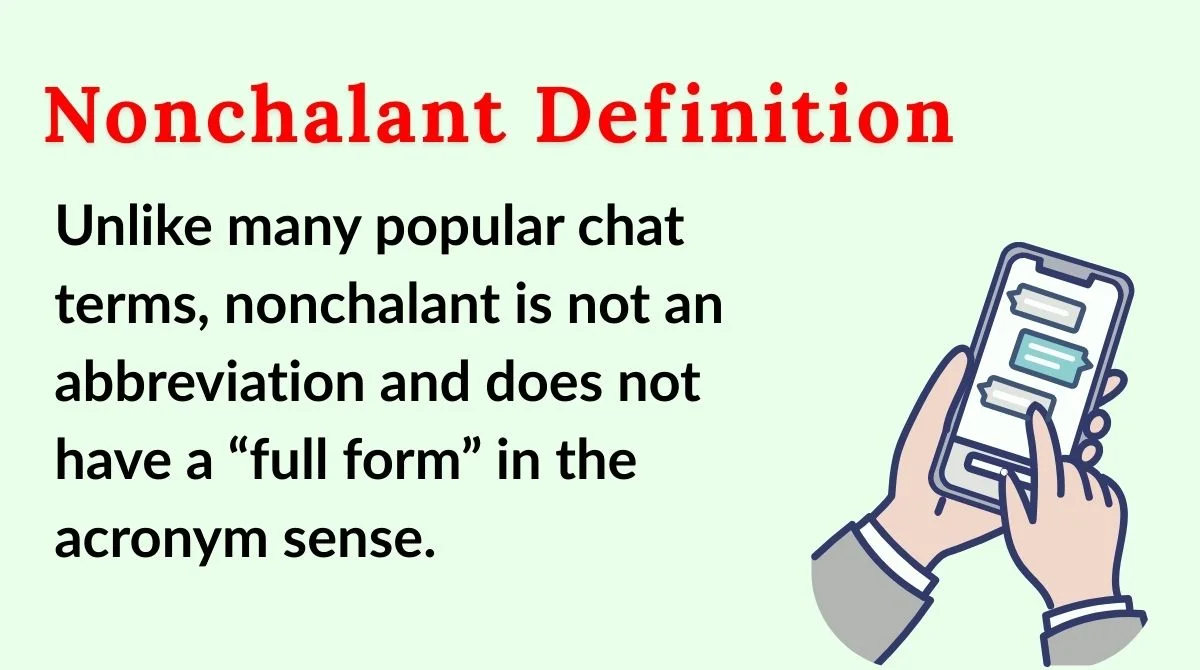
Unlike many popular chat terms, nonchalant is not an abbreviation and does not have a “full form” in the acronym sense.
It’s a complete adjective on its own, borrowed directly from formal English and adapted into casual use.
Short meaning:
Nonchalant = calm, relaxed, and not showing much concern or emotion
People sometimes assume it stands for something because it’s frequently used like slang, but it doesn’t. Its popularity in captions and comments just makes it feel modern.
Quick breakdown:
- Part of speech: Adjective
- Tone: Neutral to slightly emotional
- Common vibe: Cool, detached, effortless
You might see it paired with words like attitude, reply, expression, or energy. In SEO and dictionary searches, people often look for a simplified definition because traditional explanations feel too formal for everyday use.
Origin, History & First Known Use of Nonchalant
The word nonchalant has surprisingly classy roots. It comes from the French word “nonchaloir,” which means to not care or to be unconcerned.
The term entered the English language in the early 18th century, initially used to describe a composed or indifferent manner.
Historically, being nonchalant wasn’t always negative. In aristocratic societies, emotional restraint was considered elegant.
A nonchalant posture or expression suggested self-control, confidence, and social status. Over time, the word shifted from describing grace under pressure to signaling emotional detachment.
Key evolution points:
- 1700s: Calm, composed, refined behavior
- 1800s: Casual lack of concern
- Modern era: Emotional distance or “cool” personality
Today, social media has reshaped its tone again. A nonchalant personality might now be seen as mysterious, attractive, or emotionally unavailable—depending on perspective.
This long history explains why the word can feel both polished and slightly passive-aggressive at the same time.
How People Use Nonchalant in Daily Conversations
In everyday speech, nonchalant is often used to describe how someone reacts, not what they say. It’s about energy more than words.
You’ll hear it in conversations about dating, friendships, work behavior, and even parenting.
Common real-life uses:
- “She was surprisingly nonchalant about the news.”
- “He acted nonchalant, but I know he cared.”
- “Try to sound nonchalant during the interview.”
People also use it to critique behavior. Saying someone is nonchalant can imply they’re emotionally unavailable or not taking something seriously enough.
At the same time, it can also be praise—suggesting calmness under pressure.
In spoken conversations, tone softens the meaning. In written messages, however, it’s easier to misread. That’s why the word often causes misunderstandings, especially when emotions are involved.
Nonchalant Meaning Across WhatsApp, Instagram, TikTok & Snapchat
On social platforms, nonchalant is heavily tied to aesthetic and personality branding. It’s less about definition and more about identity.
Platform trends:
- Instagram: “Nonchalant vibes only” captions imply effortless confidence
- TikTok: Nonchalant characters are calm, quiet, and emotionally reserved
- Snapchat: Used to describe dry replies or low-effort snaps
- WhatsApp: Often points out short or delayed responses
Example captions and chats:
- “Nonchalant era 😌”
- “Why are you being so nonchalant rn?”
- “He left me on read, real nonchalant energy 💀”
Here, the word blends slang with psychology. It can be playful, ironic, or critical—all depending on context and emojis.
Different Meanings of Nonchalant in Other Fields
Outside casual speech, nonchalant still holds weight in professional and academic contexts. In psychology, it may describe emotional regulation or avoidance.
In literature, it’s used to shape character personalities—often suggesting subtle arrogance or inner conflict.
Field-specific meanings:
- Psychology: Emotional detachment or coping mechanism
- Literature: Controlled, understated character behavior
- Fashion: Effortless, unforced style
- Workplace: Calm under pressure (sometimes misread as disengagement)
The word adapts easily, which is why it stays relevant across fields. Its flexibility is also why misunderstandings happen so often.
Common Confusions, Mistakes & Wrong Interpretations
A major mistake is assuming nonchalant always means rude or uncaring. That’s not true. The word doesn’t automatically imply bad intentions—it describes appearance, not inner feelings.
Common misunderstandings:
- Confusing nonchalant with arrogant
- Assuming emotional coldness
- Using it when calm or casual would fit better
Another error is overusing it as slang. Because it sounds stylish, people sometimes force it into contexts where it doesn’t belong, weakening clarity.
Similar Terms, Alternatives & Related Slang
Depending on tone, several words can replace nonchalant.
Similar terms:
- Calm
- Casual
- Unbothered
- Indifferent
- Chill
Slang alternatives:
- “Lowkey”
- “Unbothered”
- “Cool with it”
Examples of Nonchalant in Real Chat Situations
Quick chat-style examples:
- “She was so nonchalant about the breakup 😶”
- “Why you replying nonchalant today?”
- “I’m trying to act nonchalant but I’m stressed 😂”
These short examples show how tone shifts with context and emojis.
How to Reply When Someone Says Nonchalant
Your reply depends on intent:
- If playful: “Haha, I’m just chill like that 😎”
- If concerned: “I didn’t mean to seem distant”
- If teasing: “Nonchalant is my brand now”
Reading the emotional subtext is key.
Is Nonchalant Still Popular? Trends & Online Usage
Yes—nonchalant remains popular, especially in Gen Z spaces. It’s frequently used in captions, memes, and personality descriptions.
Its mix of elegance and emotional ambiguity keeps it trendy, even as slang evolves.
FAQs: People Also Ask About Nonchalant
1. Is nonchalant a negative word?
Not always. It can be neutral, positive, or negative depending on context.
2. Does nonchalant mean rude?
No, but it can feel rude if emotional engagement is expected.
3. Can a person be naturally nonchalant?
Yes, some people naturally express emotions subtly.
4. Is nonchalant the same as indifferent?
Not exactly. Indifferent implies lack of care; nonchalant implies calmness.
5. Why is nonchalant popular on social media?
Because it represents effortless confidence and emotional control.
Conclusion
Understanding the nonchalant definition goes far beyond a simple dictionary meaning. It’s a word shaped by history, tone, and modern digital culture.
Whether it describes calm confidence or emotional distance depends entirely on context.
In texts and social media, nonchalant has become a shorthand for vibe, attitude, and personality—sometimes admired, sometimes questioned.
Knowing how and when to use it helps avoid misunderstandings and improves communication, especially online.
When you recognize the nuance behind the word, you can read conversations more accurately and respond with clarity and confidence.

✨ “Elara Winslow weaves words with wit, turning everyday thoughts into moments of joy.”