Last updated on February 26th, 2026 at 11:42 am
Music is one of the only things on Earth that can make you smile, cry, sing, dance, and sometimes pretend you’re a professional opera singer in the shower.
Whether you’re a musician, student, music lover, or someone who just discovered that notes are more than “A, B, C,” this guide is for you.
Understanding music note names matters more than you think. Notes are the ABCs of music—they help you read sheet music, write melodies, and understand why your guitar sounds beautiful… or completely off-tune.
In this post, you’ll explore 148+ music notes names, grouped in fun categories that make learning feel like play.
From basic notes to rare ones, from harmony to rhythm, from Western notation to global styles—you’re getting the full package. Ready to level up your music brain? Let’s begin! 🎶
Trivia / Fun Fact 🎤
Did you know? The note “A” we tune to today (440 Hz) was once completely different. In the 1800s, “A” could be anywhere from 420–460 Hz depending on the country. Imagine an orchestra trying to play together—chaos!
Quick Checklist Before Learning Music Note Names
Here are some simple tips to make musical learning easier:
- 🎧 Listen first — your ears learn faster than your eyes.
- ✍️ Start with basic notes before exploring advanced ones.
- 🎹 Practice on an instrument to make the names stick.
- 📖 Use visual charts for faster memory.
- 🔁 Repeat daily — even 10 minutes helps.
- 🌟 Have fun! Music is joy, not stress.
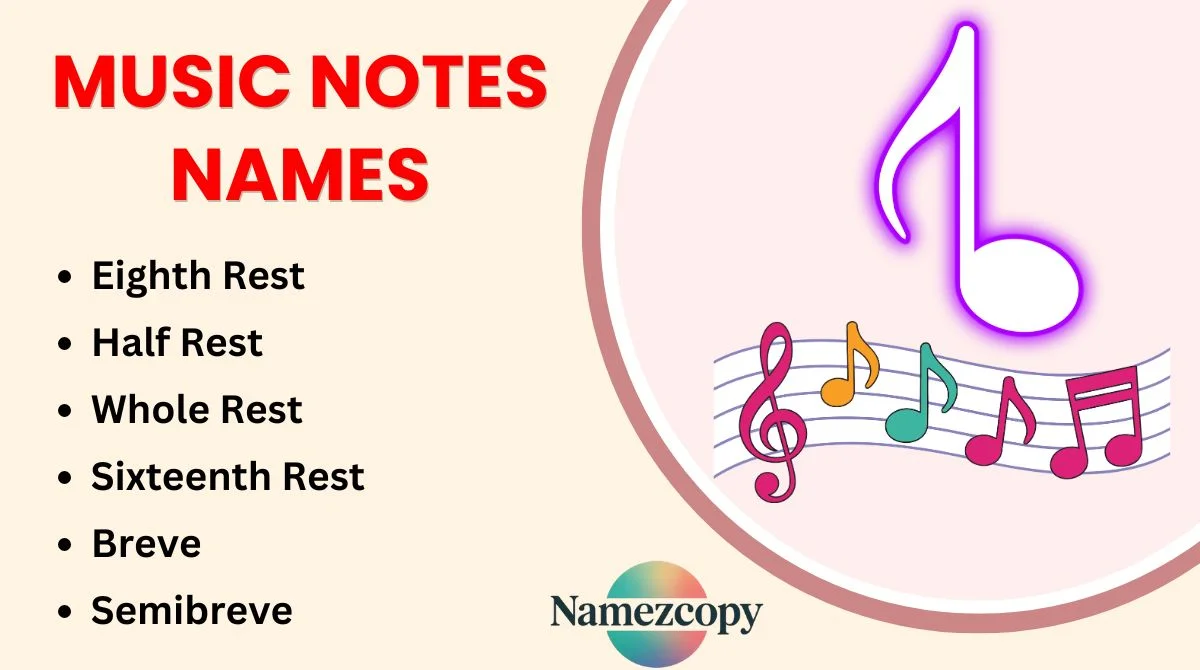
Basic Music Notes Names
- Whole Note
- Half Note
- Quarter Note
- Eighth Note
- Sixteenth Note
- Thirty-Second Note
- Sixty-Fourth Note
- Double Whole Note
- Quarter Rest
- Eighth Rest
- Half Rest
- Whole Rest
- Sixteenth Rest
- Breve
- Semibreve
👉 Which basic note do you use the most?
Western Classical Music Notes Names
- A
- B
- C
- D
- E
- F
- G
- A♯
- B♭
- C♯
- D♯
- E♭
- F♯
- G♯
- A♭
👉 Tell us your favorite scale—major or minor?
Music Notes Names and Meanings
- Whole Note (Semibreve) — A note held for four beats in common time, representing a full musical duration.
- Half Note (Minim) — Lasts for two beats; half the duration of a whole note.
- Quarter Note (Crotchet) — Played for one beat; one of the most commonly used notes.
- Eighth Note (Quaver) — Equals half a beat and often appears in pairs.
- Sixteenth Note (Semiquaver) — Very short note lasting one-quarter of a beat.
- Thirty-Second Note (Demisemiquaver) — Extremely short duration used in fast passages.
- Sixty-Fourth Note (Hemidemisemiquaver) — Used for very rapid musical expressions.
- Dotted Note — A note extended by half of its original value.
- Double Dotted Note — Increases note length by 75% of its original duration.
- Tie — Connects two notes of the same pitch to create one sustained sound.
- Rest — Indicates silence for a specific duration in music.
- Triplet — Three notes played in the time normally occupied by two.
- Grace Note — A quick decorative note played just before the main note.
- Accented Note — A note played with extra emphasis or strength.
- Staccato Note — A note played shortly and detached from others.
Rare and Unique Music Note Names
- D♭♭
- E♯
- F♭
- G♭♭
- B♯
- Double Sharp (x)
- Double Flat (♭♭)
- Augmented Note
- Diminished Note
- Enharmonic Note
- Micro Tone
- Quarter Tone
- Neutral Note
- Three-Quarter Flat
- Three-Quarter Sharp
👉 Ever played microtones before? They’re fun!
Music Note Names for Guitar Players
- Open E
- F on 1st fret
- G on 3rd fret
- A on 5th fret
- C on 8th fret
- High E
- Harmonic E
- Harmonic G
- Harmonic D
- Low E
- Power Chord Root
- Sliding Note
- Bend Note
- Pull-Off Note
- Hammer-On Note
👉 Guitarists—what’s your favorite fret for solos?
Music Notes Names for Piano Lovers
- Middle C
- High C
- Low C
- C Major
- D Minor
- F Major
- G Minor
- Bb Major
- C♯ Major
- A Minor
- Chromatic C
- C Diminished
- E Augmented
- G Suspended
- A♭ Major
👉 Do you play piano with sheet music or by ear?
Vocal Music Note Names (For Singers)
- Head Voice Note
- Chest Voice Note
- Mixed Voice Note
- Falsetto Note
- Belt Note
- Breath Note
- Vibrato Note
- Straight Tone Note
- Soft Note
- High Note
- Low Note
- Sustain Note
- Whisper Note
- Runs Note
- Resonant Note
👉 Which vocal style is your signature?
Music Notes Names in Indian Classical Music
- Sa
- Re
- Ga
- Ma
- Pa
- Dha
- Ni
- Komal Re
- Komal Ga
- Komal Dha
- Komal Ni
- Tivra Ma
- Shuddh Sa
- Shuddh Ma
- Shuddh Pa
👉 Indian classical fans—your favorite raga?
Music Note Names in Arabic / Middle Eastern Styles
- Rast
- Bayati
- Hijaz
- Nahawand
- Kurd
- Saba
- Ajam
- Sikah
- Nakriz
- Huzam
- Hijazkar
- Nawa Athar
- Ushshaq
- Mustaar
- Segah
👉 Which maqam pulls your heart strings?
Music Notes Names for Drummers (Rhythmic Notes)
- Kick Note
- Snare Note
- Hi-Hat Note
- Open Hi-Hat Note
- Ride Note
- Crash Note
- Tom Note
- Floor Tom Note
- Ghost Note
- Accent Note
- Flam Note
- Rimshot Note
- Buzz Note
- Drag Note
- Hi-Hat Foot Note
👉 Drummers—ghost notes or rimshots? Which wins?
Music Notes Names in Jazz 🎷
- Blue Note
- Chromatic Note
- Bebop Note
- Swing Note
- Passing Tone
- Leading Tone
- Altered Note
- Flat 9
- Sharp 11
- Diminished 7
- Whole Tone
- Tritone
- Syncopated Note
- Grace Note
- Scooped Note
👉 Jazz lovers—what’s your favorite “blue note”?
Music Notes Names and Symbols
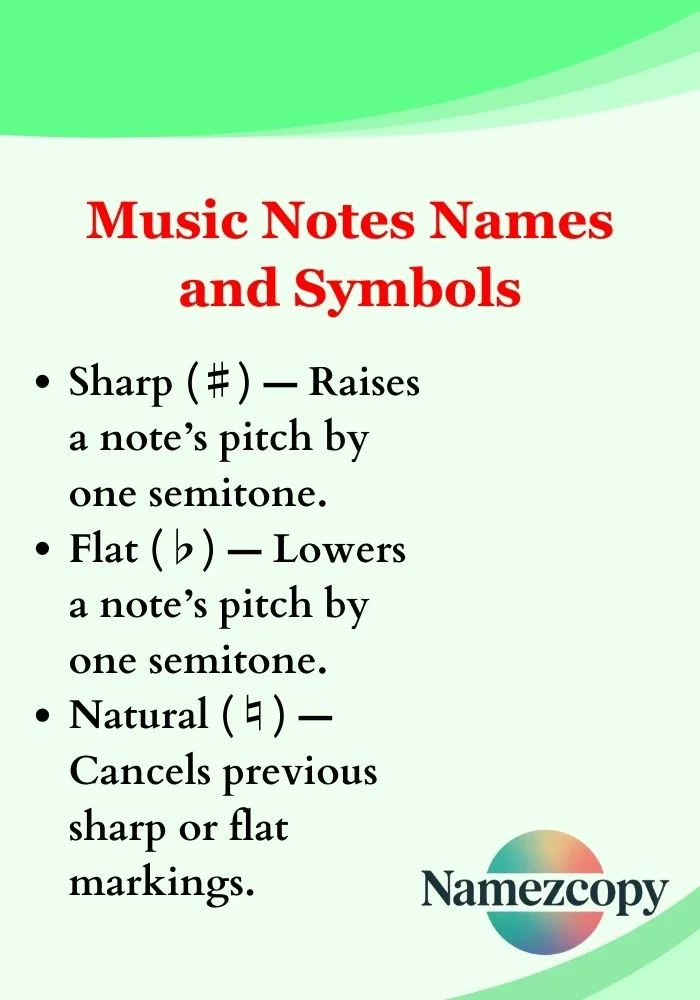
- Treble Clef (𝄞) — Symbol indicating higher pitch ranges, commonly for vocals and melody instruments.
- Bass Clef (𝄢) — Used for lower pitch instruments like bass guitar or cello.
- Sharp (♯) — Raises a note’s pitch by one semitone.
- Flat (♭) — Lowers a note’s pitch by one semitone.
- Natural (♮) — Cancels previous sharp or flat markings.
- Whole Note Symbol (𝅝) — Oval-shaped note without a stem.
- Half Note Symbol (𝅗𝅥) — Hollow note head with a stem.
- Quarter Note Symbol (♩) — Filled note head with a stem.
- Eighth Note Symbol (♪) — Filled note with one flag.
- Beamed Notes (♫) — Connected eighth or shorter notes.
- Rest Symbol (𝄽) — Represents silence in written music.
- Fermata (𝄐) — Indicates a note should be held longer than written.
- Repeat Sign (𝄆 𝄇) — Shows a section should be played again.
- Time Signature (e.g., 4/4) — Indicates beats per measure and note value.
- Crescendo ( < ) — Gradual increase in volume.
How We Create Music Notes
Here’s a simple way musicians learn or create music note patterns:
- 🎼 Start with the scale
Pick a home scale—major, minor, or modal. - 🎹 Add intervals
Add steps like whole, half, or microtonal intervals. - ✍️ Write melodic patterns
Go up, down, jump, or repeat notes. - 🎧 Test with your instrument
Hear how notes sound together. - 🔁 Revise
Keep what sounds good. Remove what doesn’t. - 🎤 Add rhythm
Notes + timing = music magic.
Tips for Making Your Music Stand Out
- Use variations of notes to make your melody fresh.
- Mix short and long notes for better flow.
- Try unexpected intervals for a dramatic effect.
- Keep things simple—overloaded notes confuse listeners.
- Use emotion as your guide; pick notes that feel right.
FAQs
What are the basic music notes names?
Basic note names are A, B, C, D, E, F, and G. These repeat in octaves and form the foundation of Western music.
What are the 12 notes in music?
The chromatic set includes A, A♯/B♭, B, C, C♯/D♭, D, D♯/E♭, E, F, F♯/G♭, G, G♯/A♭.
What are advanced music note names?
Advanced notes include double sharps, double flats, enharmonic notes, microtones, and altered jazz tones.
Are music note names the same on all instruments?
Yes! Whether piano or guitar, the note names stay the same—but their positions differ.
What is the easiest way to remember note names?
Use charts, apps, color-coded stickers, and daily 10-minute practice.
What are music note names for beginners?
Start with simple notes: A, B, C, D, E, F, G and basic rhythmic notes like whole, half, and quarter.
Conclusion
Music notes are the building blocks of every melody you love. The more names you learn, the easier it becomes to read music, write songs, or play like a pro.
Now that you’ve explored 148+ music notes names, you’re ready to level up your musical world.
🎵 Which note name is your favorite? Share in the comments!

✨ “Elara Winslow weaves words with wit, turning everyday thoughts into moments of joy.”