If you’ve ever seen someone type “LWK” in a message and paused to wonder what it means, you’re not alone.
Internet slang evolves fast, and short abbreviations like LWK often carry layered meanings depending on context, platform, and tone.
People search for “LWK meaning in text” because it shows up frequently in casual chats, social media comments, and even memes—but rarely comes with an explanation.
Understanding LWK can help you avoid confusion, respond more naturally, and stay fluent in modern digital conversations. In this guide, we’ll break down what LWK means, where it came from, and how people actually use it today.
Whether you’re texting friends, scrolling TikTok, or decoding Instagram captions, this article will give you a clear, simple, and human explanation—no slang dictionary required.
What Does LWK Mean in Text & Chat?
In text messages and online chats, LWK most commonly means “Low-Key.” It’s a shortened slang version people use to express something subtly, casually, or without making a big deal about it.
When someone says LWK, they’re usually admitting a feeling or opinion—but in a relaxed, understated way.
For example, if someone texts, “I LWK miss those days,” they’re saying they miss them a little, or quietly, without sounding dramatic.
The tone is often honest but chill. That’s why LWK fits perfectly into modern texting culture, where people like to keep things casual and unfiltered.
LWK can also be used to soften statements. Instead of saying something directly, it adds a layer of emotional safety.
Saying “I like it” feels strong, but “I LWK like it” feels easier and less intense. This makes LWK popular in conversations about feelings, opinions, or reactions.
Quick examples:
- “That movie was LWK scary 😅”
- “I’m LWK tired today.”
- “LWK proud of myself.”
In short, LWK signals subtle honesty—you feel it, but you’re not shouting it.
Full Form, Stands For & Short Meaning of LWK
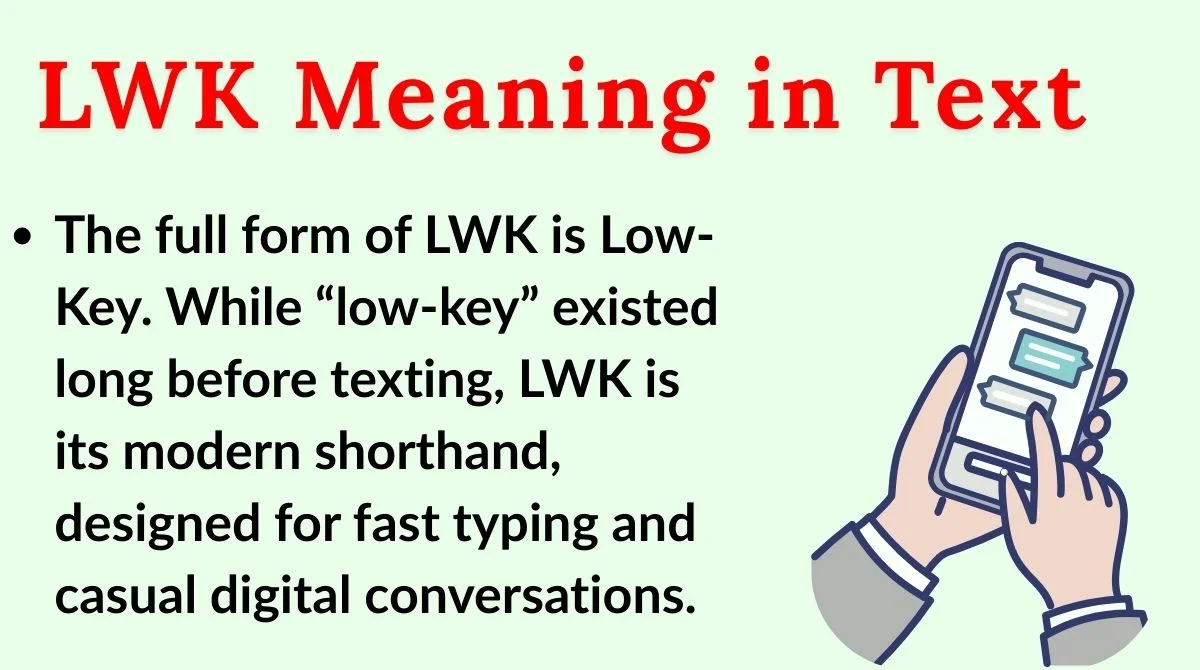
The full form of LWK is Low-Key. While “low-key” existed long before texting, LWK is its modern shorthand, designed for fast typing and casual digital conversations. It doesn’t stand for a longer phrase beyond that—it’s simply an abbreviation.
Short meaning of LWK:
👉 Quietly, slightly, subtly, or casually.
People use LWK when they want to:
- Downplay emotions
- Sound relaxed or ironic
- Avoid being too serious
Compared to typing “low-key,” LWK feels more slang-heavy and internet-native. It’s especially common among Gen Z and younger millennials who favor short, expressive abbreviations.
You’ll often see it placed before verbs or adjectives:
- LWK funny
- LWK annoyed
- LWK want that
Think of LWK as a tone-setter. It tells the reader, “I feel this… but not in an intense way.”
Origin, History & First Known Use of LWK
The phrase “low-key” originally comes from music and lighting terminology, meaning something toned down or not overly dramatic. Over time, it entered everyday language to describe subtle behavior or emotions.
The abbreviation LWK emerged much later, alongside the rise of texting, instant messaging, and social media. As character limits and fast replies became the norm, users began shortening common phrases. LWK naturally evolved as a compact version of “low-key.”
Its first widespread usage appeared in informal online spaces like:
- SMS texting
- Twitter replies
- Tumblr and early meme culture
As slang became more phonetic and abbreviated, LWK stuck because it was easy to type and instantly recognizable to digital natives. Unlike older acronyms, LWK didn’t need explanation—it spread organically through usage.
Today, LWK is less about efficiency and more about vibe. It signals casual honesty and fits perfectly into modern internet tone culture.
How People Use LWK in Daily Conversations
In everyday texting, LWK is used to express thoughts that are real—but not overwhelming. It helps people communicate feelings without sounding too serious or vulnerable. That’s why it shows up so often in personal chats.
Common use cases include:
- Admitting feelings
- Sharing opinions
- Reacting to situations
Examples:
- “I LWK want pizza rn 🍕”
- “That test was LWK hard.”
- “LWK miss talking to you.”
Notice how LWK softens the message. Without it, the sentence might feel stronger or more direct. With LWK, it feels safer and more conversational.
It’s also frequently used as a hedge—giving someone room to agree or disagree without pressure. That subtlety is what makes LWK so popular in modern communication.
LWK Meaning Across WhatsApp, Instagram, TikTok & Snapchat
While the meaning of LWK stays mostly consistent, its tone can shift depending on the platform.
- WhatsApp: Used in private chats to express honest but chill feelings.
“LWK stressed today.” - Instagram: Common in captions or comments, often ironic.
“LWK obsessed with this fit.” - TikTok: Used in comments to agree subtly or react humorously.
“This video is LWK relatable 😂” - Snapchat: Casual and emotional, often paired with selfies.
“LWK tired but still cute.”
Across platforms, LWK keeps things light and relatable. It rarely sounds serious or formal.
Different Meanings of LWK in Other Fields
Outside of slang, LWK can occasionally mean different things depending on context. In technical or professional fields, it may appear as:
- A location or airport code
- An internal abbreviation in business or gaming
- A username or brand shorthand
However, these meanings are niche. In everyday texting and social media, LWK almost always means “low-key.” Context is key—if the conversation is casual, slang is the safe interpretation.
Common Confusions, Mistakes & Wrong Interpretations
Some people mistake LWK for:
- A typo
- A random acronym
- Something negative or sarcastic
Another common confusion is mixing it up with “IDK” or “FWIW.” Unlike those, LWK isn’t about knowledge—it’s about tone.
Mistakes to avoid:
- Assuming it’s serious
- Reading it as passive-aggressive
- Overthinking it
If in doubt, read LWK as “a little” or “kind of.” That usually clears things up.
Similar Terms, Alternatives & Related Slang
LWK has several slang cousins that serve a similar purpose:
- Lowkey (full word)
- Kinda
- Sorta
- A bit
- TBH (for honesty)
Examples of LWK in Real Chat Situations
- “I LWK like that song 🎧”
- “LWK nervous about tomorrow.”
- “This weather is LWK perfect 😌”
- “I’m LWK hungry again.”
These examples show how natural and flexible LWK is in conversation.
How to Reply When Someone Says LWK
You don’t need to overthink your reply. Match the tone:
- Agree casually: “Same tbh.”
- Ask more: “Why tho?”
- React lightly: “Haha I feel that.”
If someone says something emotional with LWK, it’s usually an invitation for low-pressure conversation.
Is LWK Still Popular? Trends & Online Usage
Yes—LWK is still very popular, especially among younger users. While slang changes fast, LWK has staying power because it fills a real communication need: expressing honesty without intensity.
It’s not overly trendy or dated, which makes it a stable part of modern internet language.
FAQs: What People Also Ask About LWK Meaning in Text
1. Does LWK always mean low-key?
Yes, in texting and social media, that’s almost always the meaning.
2. Is LWK positive or negative?
It depends on context—it can be either.
3. Is LWK formal language?
No, it’s casual slang.
4. Can adults use LWK?
Absolutely. It’s age-neutral, just informal.
5. Is LWK the same as “kinda”?
Very similar, but LWK adds more emotional tone.
Conclusion
The meaning of LWK in text is simple but powerful. Short for low-key, it helps people express thoughts and feelings in a relaxed, understated way.
Whether someone is LWK tired, LWK excited, or LWK missing something, the term keeps conversations honest without being intense.
As texting and social media continue to shape how we communicate, abbreviations like LWK play a big role in setting tone and mood.
Now that you know what it means—and how to use it—you can read messages more clearly and reply more naturally.
Next time you see LWK pop up in a chat, you’ll know exactly what vibe it’s giving.

✨ “Elara Winslow weaves words with wit, turning everyday thoughts into moments of joy.”