The term aggregate is commonly searched because it appears across many areas—academics, business, data analysis, construction, and even casual explanations online.
People want a clear, simple aggregate definition because the word can feel technical at first glance.
At its core, aggregate is about bringing things together, but its exact meaning shifts slightly depending on context.
Whether you’re reading a report, chatting about statistics, studying economics, or trying to understand a technical document, knowing what aggregate means helps you follow the bigger picture.
This article breaks down the meaning of aggregate in plain English, explores how it’s used in daily conversations and digital platforms, and clears up common misunderstandings.
No jargon overload—just clear, friendly explanations you can actually use.
What Does Aggregate Mean in Text & Chat?
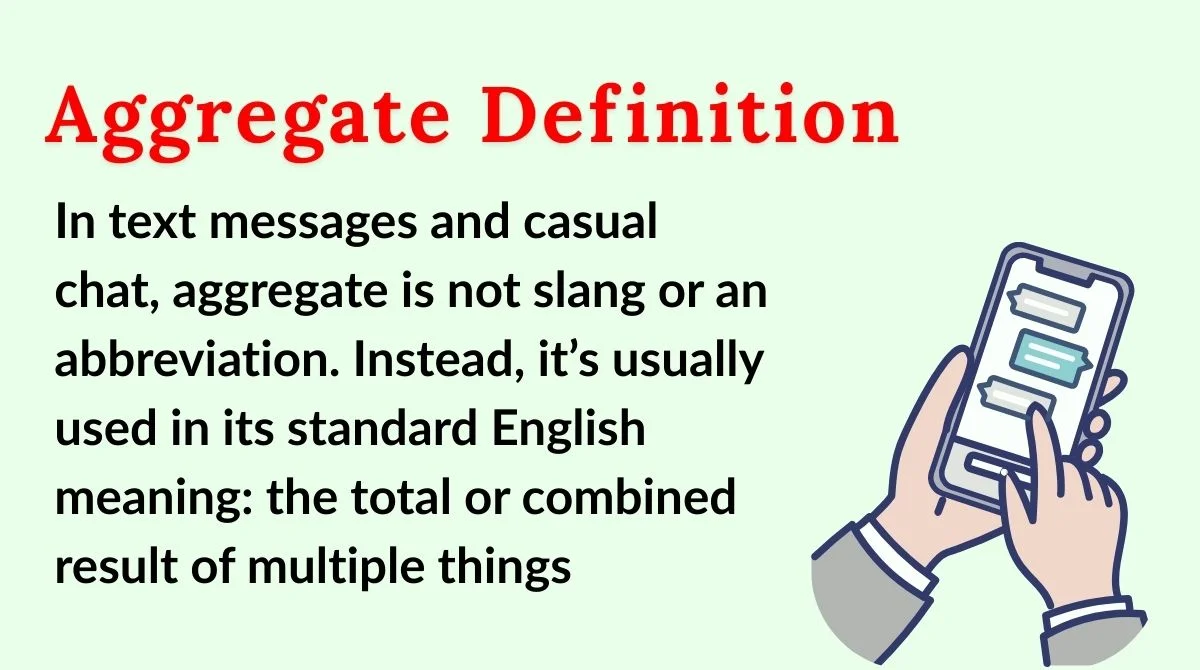
In text messages and casual chat, aggregate is not slang or an abbreviation. Instead, it’s usually used in its standard English meaning: the total or combined result of multiple things.
When someone uses aggregate in chat, they’re often trying to sound precise or explanatory rather than casual.
In simple terms:
- Aggregate = everything added together
- Focuses on the whole, not individual parts
Quick chat-style examples:
- “In aggregate, we spent more than expected 💸”
- “The aggregate score puts us in first place!”
- “Looking at the aggregate data, trends are clear 👀”
It’s more common in informative or semi-formal conversations than everyday slang chats.
Full Form, Stands For & Short Meaning of Aggregate
Aggregate is not an acronym, so it doesn’t have a “full form.” It is a standalone English word.
Short meaning:
- A total, sum, or combined whole
As different parts of speech:
- Noun: A total formed by combining parts
“The aggregate of all sales” - Verb: To collect or gather together
“We aggregated the results” - Adjective: Describing something combined
“Aggregate demand”
This flexibility is why the word appears in so many fields.
Origin, History & First Known Use of Aggregate
The word aggregate comes from the Latin aggregare, meaning “to add to” or “to gather into a whole.” It entered English in the early 15th century, originally used in scholarly and philosophical writing.
Over time, its meaning stayed remarkably stable. While many words evolve dramatically, aggregate has consistently meant bringing separate elements together. As science, economics, and data analysis grew, the word became more common in technical and professional language.
Today, its long history gives it credibility and precision, which is why it’s favored in reports, research, and analysis-heavy discussions.
How People Use Aggregate in Daily Conversations
In everyday speech, aggregate is usually used when summarizing information or explaining results.
Common situations:
- Talking about total costs or expenses
- Explaining survey or poll results
- Summarizing performance or outcomes
Examples:
- “The aggregate cost was higher than planned.”
- “In aggregate, these habits really help.”
- “Our aggregate score improved this year.”
People often switch to simpler words like total or overall in casual talk, but aggregate adds clarity when details matter.
Aggregate Meaning Across WhatsApp, Instagram, TikTok & Snapchat
Across social platforms, aggregate keeps its original meaning. It’s not a trending slang term.
- WhatsApp: Used in work, school, or group planning chats
- Instagram: Appears in educational posts or data-based captions
- TikTok: Common in explainer videos and finance content
- Snapchat: Rare, but still understood when used
Example caption:
- “Looking at the aggregate data, this trend is wild 📊🔥”
Different Meanings of Aggregate in Other Fields
Aggregate takes on specialized meanings depending on the field:
- Economics: Total economic measures (aggregate demand, supply)
- Construction: Materials like sand, gravel, or crushed stone
- Data & Statistics: Combined data values
- Education: Cumulative scores or grades
- Business: Overall performance metrics
Despite these variations, the core idea—combining many into one—never changes.
Common Confusions, Mistakes & Wrong Interpretations
People often misunderstand aggregate as meaning average. That’s incorrect.
Common mistakes:
- ❌ Aggregate = average
- ❌ Aggregate = estimate
- ❌ Aggregate = random collection
Correct understanding:
- ✅ Aggregate = total or combined result
An average divides data; an aggregate adds it together.
Similar Terms, Alternatives & Related Words
Depending on context, you can use:
- Total
- Overall
- Combined
- Cumulative
- Sum
- Collective
Examples of Aggregate in Real Chat Situations
- “In aggregate, the feedback is positive 😊”
- “Our aggregate score beat last year’s!”
- “The aggregate cost includes taxes 💰”
- “Looking at it in aggregate makes more sense.”
How to Reply When Someone Says Aggregate
Your reply depends on context:
- “Got it—so the total result?”
- “Do you mean overall or broken down?”
- “That makes sense when viewed in aggregate 👍”
These responses show understanding and invite clarity.
Is Aggregate Still Popular? Trends & Online Usage
Yes—aggregate remains widely used, especially in:
- Finance and investing
- Data-driven content
- Business communication
- Educational platforms
While it’s not viral slang, its relevance is steady and long-term due to its usefulness and precision.
FAQs: What People Also Ask
1. What is the simple definition of aggregate?
It means the total formed by combining multiple parts.
2. Is aggregate the same as average?
No. Aggregate adds everything together; average divides it.
3. Is aggregate formal English?
It’s neutral—common in professional and educational contexts.
4. Can aggregate be used as a verb?
Yes. Example: “We aggregated the data.”
5. Why is aggregate important in data analysis?
It helps show overall patterns and totals clearly.
Conclusion
Understanding the aggregate definition makes complex information much easier to follow.
Whether you’re reading reports, analyzing data, or explaining results, aggregate helps you focus on the big picture rather than isolated details.
While it’s not casual slang, it’s a powerful, precise word that stays relevant across industries and platforms.
By knowing how aggregate works—as a noun, verb, and adjective—you can use it confidently and correctly.
Remember, it always comes back to one simple idea: many parts coming together as one whole. Once you grasp that, the word becomes intuitive, useful, and surprisingly versatile.

✨ “Elara Winslow weaves words with wit, turning everyday thoughts into moments of joy.”