The phrase ETA meaning in text is commonly searched because people see “ETA” everywhere—texts, chats, emails, and social media—but aren’t always sure what it means in casual conversations.
While ETA has been around for decades, its usage has expanded far beyond formal travel or business settings.
Today, it’s a quick, convenient way to ask about timing, arrival, or availability in everyday digital communication.
Whether someone is waiting for a friend, a delivery, or a reply, ETA keeps conversations efficient and clear.
But depending on the context, it can sometimes cause confusion. This guide breaks down exactly what ETA means in text, where it comes from, how it’s used across platforms, and how you should reply when someone sends it.
By the end, you’ll understand ETA completely—and use it confidently.
What Does ETA Mean in Text & Chat?
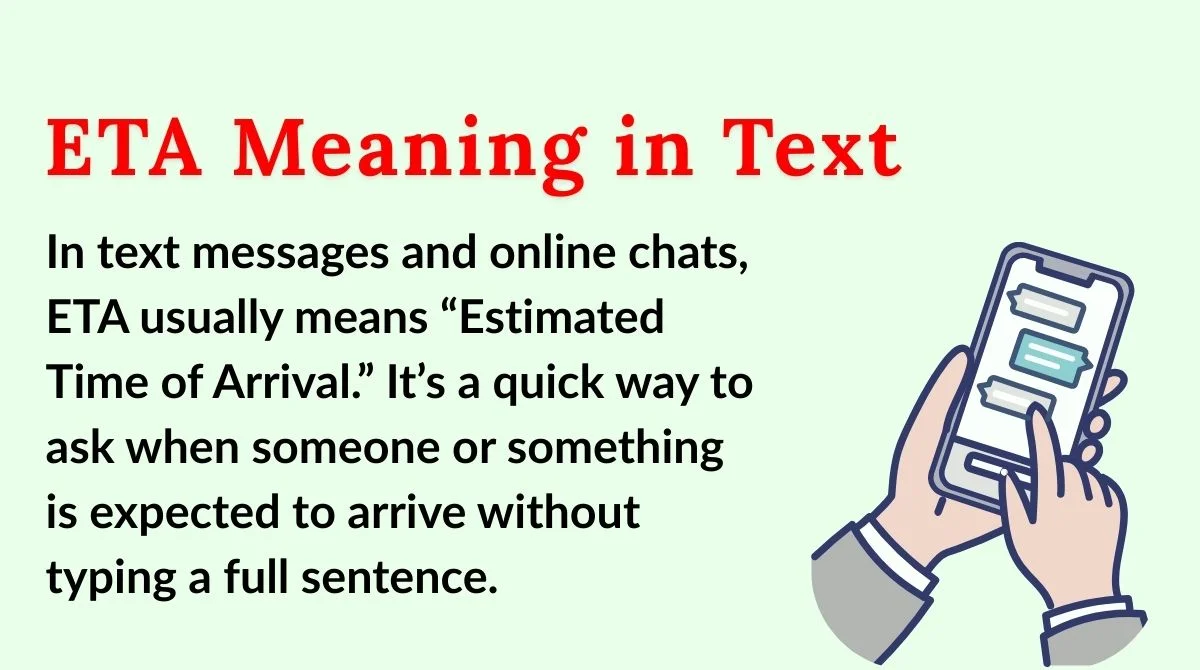
In text messages and online chats, ETA usually means “Estimated Time of Arrival.” It’s a quick way to ask when someone or something is expected to arrive without typing a full sentence.
People use ETA when:
- They’re waiting on someone
- They want an update on timing
- They need quick clarity
In casual texting, ETA often replaces questions like:
- “When will you be here?”
- “How long will it take?”
- “What time are you arriving?”
Common chat uses:
- “What’s your ETA?”
- “ETA on the food?”
- “Any ETA yet?”
Short, efficient, and universally understood, ETA saves time and keeps conversations moving. In chats, it’s almost always informal and friendly—not demanding—especially when paired with emojis or soft language.
Full Form, Stands For & Short Meaning of ETA
The full form of ETA is Estimated Time of Arrival.
Breakdown:
- Estimated → Not exact, just a prediction
- Time → The moment or duration
- Arrival → When someone or something reaches a place
Short meaning in text:
👉 “About when will you arrive?”
Although it originated as a technical term, ETA is now widely used in:
- Text messages
- Emails
- Workplace chats
- Social media DMs
Because it’s an estimate, ETA allows flexibility. It communicates timing without promising precision, which makes it perfect for modern, fast-paced conversations.
Origin, History & First Known Use of ETA
ETA originated in the aviation and military industries in the early 20th century. Pilots and commanders needed a standardized way to communicate arrival times efficiently and clearly.
Over time, ETA spread to:
- Shipping and logistics
- Public transportation
- Business communication
With the rise of mobile phones and texting in the early 2000s, ETA naturally moved into casual language. Its simplicity made it ideal for short messages, and today it’s fully embedded in digital culture.
What started as a technical term is now everyday slang—proof that practical language always survives.
How People Use ETA in Daily Conversations
In daily life, ETA is used casually and politely. Tone depends on context.
Everyday examples:
- “Running late—new ETA is 6:30.”
- “What’s your ETA to the party?”
- “ETA on the package?”
Why people love ETA:
- Saves time
- Sounds neutral
- Works in any situation
It’s commonly used for:
- Meetups
- Deliveries
- Work updates
- Travel plans
ETA doesn’t pressure—it informs. That’s why it remains popular across age groups and platforms.
ETA Meaning Across WhatsApp, Instagram, TikTok & Snapchat
The ETA meaning in text stays consistent across platforms, but tone changes.
WhatsApp:
- “ETA?” (quick and direct)
- “What’s your ETA 😊”
Instagram DMs:
- Often casual or playful
- “ETA on that post? 👀”
TikTok comments:
- Used humorously
- “ETA for part 2 😂”
Snapchat:
- Short and friendly
- “ETA home?”
Across all platforms, ETA means when something is coming, whether that’s a person, post, or reply.
Different Meanings of ETA in Other Fields
While texting uses ETA casually, other fields use it more formally.
Aviation & Travel:
- Exact arrival estimates for flights
Logistics & Shipping:
- Delivery timelines
Project Management:
- Completion forecasts
Finance (rare):
- Earnings-related timelines (context-dependent)
In non-text settings, ETA is often tracked, updated, and monitored closely—unlike casual chat usage.
Common Confusions, Mistakes & Wrong Interpretations
Despite its popularity, ETA can confuse people.
Common mistakes:
- Thinking ETA is a promise (it’s not)
- Confusing it with exact time
- Assuming urgency
Wrong interpretations:
- “Why are they rushing me?”
- “They want a precise time”
ETA is neutral. It’s a request for an estimate—not pressure.
Similar Terms, Alternatives & Related Slang
If you want alternatives to ETA, here are common ones:
- TTYL – Talk to you later
- BRB – Be right back
- OMW – On my way
- ASAP – As soon as possible
Examples of ETA in Real Chat Situations
Quick chat examples:
- “ETA?”
- “What’s your ETA to work?”
- “Food ETA? 🍔”
Friendly tone:
- “Any ETA? No rush 😊”
- “ETA home? 🚗”
These short messages feel natural and polite in daily texting.
How to Reply When Someone Says ETA
How you reply depends on accuracy.
Good responses:
- “ETA is 15 minutes.”
- “About 6 PM.”
- “Running late—new ETA soon.”
If unsure:
- “Not sure yet, will update.”
- “Traffic’s bad, ETA TBD.”
Honesty is better than precision.
Is ETA Still Popular? Trends & Online Usage
Yes—ETA is still extremely popular. Its usage continues to grow thanks to:
- Messaging apps
- Remote work
- Delivery culture
Short, efficient abbreviations thrive online, and ETA fits perfectly. It’s unlikely to disappear anytime soon.
FAQs: ETA Meaning in Text
1. What does ETA mean in texting?
It means Estimated Time of Arrival.
2. Is ETA rude to ask?
No, it’s neutral and commonly used.
3. Can ETA be used casually?
Yes, especially in chats and DMs.
4. Does ETA mean exact time?
No, it’s only an estimate.
5. Is ETA still used today?
Absolutely—it’s more popular than ever.
Conclusion
Understanding the ETA meaning in text makes modern communication easier and clearer. From casual chats to work messages, ETA helps people manage expectations without overexplaining.
Its strength lies in simplicity—it asks for timing without pressure and allows flexibility when plans change.
Whether you’re texting a friend, waiting on food, or coordinating schedules, ETA keeps things smooth and efficient.
Now that you know its meaning, origin, and proper usage, you can read and respond to ETA confidently.
Simple, timeless, and practical—ETA remains one of the most useful abbreviations in digital communication today.

✨ “Elara Winslow weaves words with wit, turning everyday thoughts into moments of joy.”